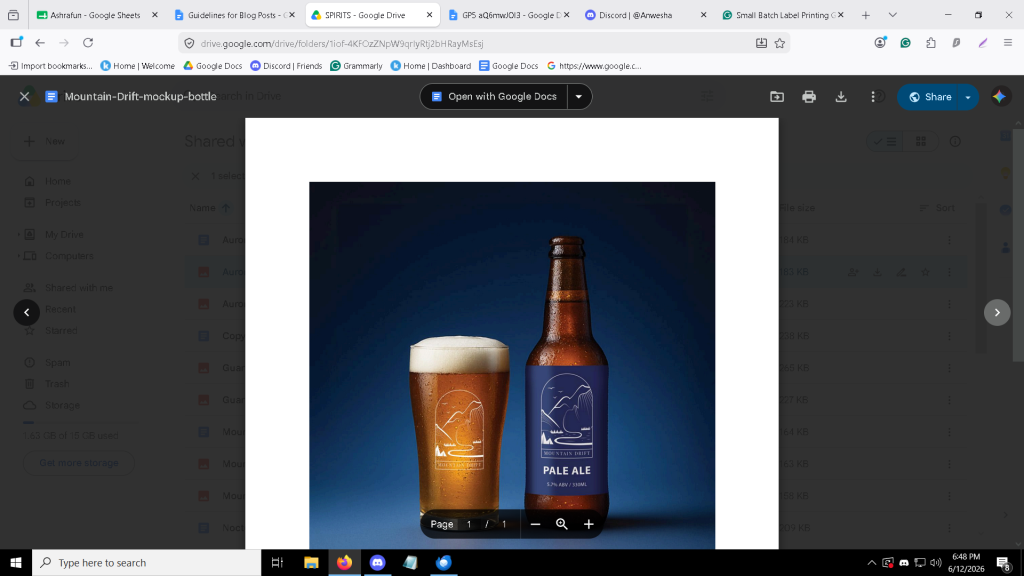
There is a common assumption that affordable stickers will always look cheap. Flimsy material, dull colours, edges that lift after a week. It is an understandable worry, especially when a product’s packaging is often the first thing a customer actually touches. The good news is that the assumption is mostly wrong. Price and quality are not as linked as people think, at least not when you understand what actually drives the cost of a label.
Where The Money Actually Goes
Affordable stickers tend to cost less for reasons that have nothing to do with print quality. Order volume, material selection, and artwork complexity are the main factors. A small run of simple labels on a standard material will cost less than a large order on a specialty substrate, and both can look sharp.
Here is what genuinely affects how a label looks:
- Artwork resolution and file quality
- The finish chosen, matte or gloss
- The material selected for the product’s storage conditions
- Print method and colour accuracy
None of those requires a large budget. They require good decisions upfront.
The Finish Does More Work Than You Think
Perhaps the quickest way to make an affordable sticker look more considered is to choose the finish carefully.
Gloss finish reflects light and makes colours appear more saturated. It reads well on products displayed in retail environments where labels compete for attention. A beverage bottle with a gloss label, even a simple one, tends to look polished under store lighting.
Matte finish does something different. It absorbs light rather than reflecting it, which gives a product a quieter, more restrained appearance. Skincare and cosmetic brands often lean toward matte because it reads as considered rather than loud.
The choice between the two is less about cost and more about what the product is trying to communicate.
Material Is Where People Get It Wrong
Choosing the wrong material is probably the most common reason an otherwise decent-looking label ends up failing. Not always immediately, but eventually.
Paper labels suit dry, indoor products well. They print cleanly, they cost less, and for most general retail applications, they are the right call. A candle, a dry food product, a boxed item, and paperwork work fine.
Where things go wrong is when paper labels end up on products that are exposed to moisture. A body lotion sitting in a bathroom, a cold drink pulled from a fridge, a bottle that sweats in summer, these conditions test paper labels quickly. Edges lift. The surface softens. The label starts to look worn before the product is even close to finished.
White polypropylene handles those conditions far better. It resists moisture, stays adhered through condensation, and keeps its appearance through refrigerated storage. For beverage labels and cosmetic packaging especially, it is worth the small price difference.
One thing to be clear on: polypropylene suits indoor and refrigerated environments. It is not intended for prolonged outdoor exposure.
Artwork Quality Changes Everything
This is perhaps the most underrated part of getting an affordable sticker to look premium.
A label printed from a low-resolution file will look soft, regardless of the material or finish. Colours may shift. Text may appear slightly blurred at smaller sizes. None of that reflects the print process; it reflects the file.
A few things worth checking before submitting artwork:
- Resolution should be at least 300 dpi.
- Colours should be set up in CMYK rather than RGB.
- Fonts should be outlined or embedded.
- There should be enough clear space around the edges to avoid content being cut too close.
Getting the file right costs nothing. It just takes a little preparation. And the difference between a well-prepared file and a poorly prepared one is visible in the finished label.
Small Runs Are Not A Compromise
One thing that has changed in label printing is the accessibility of short-run digital orders. A small business ordering 100 labels gets the same print quality as one ordering 10,000. Digital printing does not require minimum runs to achieve sharp results.
This matters for affordable stickers because it means a brand starting out does not need to commit to large volumes to get a good-looking label. Orders are printed to specification, not pulled from pre-made stock.
The process is also straightforward. Artwork gets uploaded, specs get selected, and a quote is generated. No back and forth, no waiting for a representative to confirm anything.
The Part That Often Gets Overlooked
A label that looks good on day one and starts peeling or fading by week three does more damage than a plain label would. Customers notice. It raises questions about the product itself, not just the packaging.
Getting the material and finish right from the start avoids that entirely. It is a small decision that carries through the entire shelf life of a product.