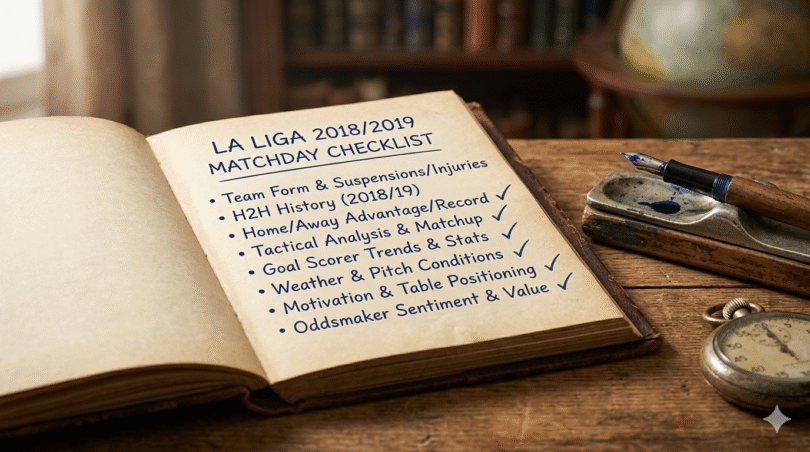

Professional bettors rarely rely on instinct. Instead, they operate through repeatable frameworks that minimize bias and create consistency across decisions. During the 2018/2019 La Liga season—known for tactical diversity and unpredictable outcomes—a structured checklist proved essential. Building one for yourself transforms casual prediction into a disciplined, data-led process for every fixture.
Why a Checklist Elevates Betting Consistency
Human judgment biases thrive under uncertainty. A pre-match checklist limits those blind spots by standardizing data collection and decision flow. Each factor—form, xG trends, injuries, fatigue, and motivation—must be verified systematically before placing a bet. For La Liga 2018/2019, this structure was particularly useful against the backdrop of fixture congestion, midseason fatigue, and contrasting tactical styles across clubs.
Core Components of a Pre-Match Evaluation
A systematic framework starts with essential questions answered objectively. The following elements cover both performance measurement and market alignment:
| Evaluation Category | Key Focus | Reason It Matters |
| Team Form Curve | Last 5–6 matches by xG differential | Reveals underlying strength, not headline results |
| Tactical Setup | Pressing height, formation continuity | Affects pace and goal probability |
| Squad Rotation | Recovery days and player fatigue | Predictors of inconsistency |
| Home/Away Profile | Possession vs. counter balance | Determines control and tempo stability |
| Motivation Index | Cup or continental distractions | Distorts expected effort level |
| Market Movement | Line shifts 24h before KO | Reflects professional money sentiment |
Evaluating these dimensions pre-game naturally filters overconfidence and replaces guesswork with probability discipline. Bettors applying this rule across La Liga’s 2018/2019 season found tighter variance and improved return symmetry.
Integrating Team Metrics Through UFABET
In situations where one aims to align predictive systems with live pricing, data availability through ทางเข้า ยูฟ่าเบท becomes a key analytical trigger. By correlating La Liga match data—xG trends, match tempo, and betting line movements—users can identify value fluctuations before kick-off. This sports betting service centralizes multiple live feeds, helping bettors verify checklist variables in real time without cross-referencing scattered sources. When used consistently, it transforms a routine checklist into a dynamic decision engine that merges tactical understanding with live market calibration.
The Tactical and Statistical Dimension
Beyond win–loss narratives, La Liga’s 2018/2019 season emphasized structural style patterns that shaped betting opportunities.
- High-press teams (Sevilla, Real Betis) inflated corner totals and early goals.
- Compact defensive sides (Valladolid, Getafe) reduced shooting volume and favored unders.
By adjusting checklist items for tactical character, bettors could identify how style dictated statistical rhythm—directly translating to total, handicap, or Both Teams to Score markets.
Mental Filters Before Confirmation
A practical pre-bet checklist must also include emotional and psychological safeguards. Bettors often overexpose following short-term loss streaks or inflated confidence after wins. Setting pre-match limits—risk cap per fixture, maximum total wagers per matchday, and avoidance of impulse line chasing—eliminates self-sabotage. These behavioral controls complement data evaluation, preserving financial stability while sustaining analytical objectivity.
Example: Applying the Checklist in a Real Fixture
During Week 23 of the 2018/2019 season, Betis faced Leganés. Data flagged reduced xG creation after midweek Copa exertion, alongside six changes in the starting lineup. Odds movement failed to adjust for fatigue indicators, signaling overvaluation for Betis. The checklist’s “Squad Rotation” and “Motivation Index” fields confirmed avoidance value—preventing irrational commitment to a supposed favorite. This logic-driven process delivered consistent risk control across multiple rounds.
Using casino online Analytical Dashboards for Secondary Verification
Where bettors sought external correlation of analytical assumptions, reviewing league-wide probability distributions through casino online data dashboards added another checkpoint. These systems aggregate expected goal variance and historical betting trends across similar match conditions, providing a sanity filter against bias. By cross-verifying checklist findings within broader datasets, bettors validate whether their planned exposure aligns with long-term winning behavior rather than isolated logic or personal narrative. This reinforces discipline while strengthening predictive confidence.
Checklist Refinement Across the Season
No checklist remains static. As La Liga progresses, metric weightings evolve—pressing intensity metrics rise post-winter breaks, and xG differentials normalize among mid-table teams. Adjusting column thresholds or adding sub-fields for weather, referee statistics, or goalkeeping quality keeps the system adaptive yet consistent. This personalization sharpens alignment between tactical evolution and numerical analysis.
Common Failures in Checklist Implementation
Checklists fail when bettors skip entries under emotional pressure or treat them as formalities rather than decision gates. Each verified field should represent a “go/no-go” condition that halts irrational betting. The structure succeeds only when used rigorously before every wager—especially during congested weeks featuring simultaneous fixtures and form volatility.
Summary
Creating a reliable La Liga 2018/2019 betting checklist ensured process consistency and reduced emotional variance. By translating tactical insight into structured verification—supported by data tools and self-regulation—bettors built habits that outlasted any single season’s unpredictability. Discipline is not about betting more accurately—it’s about betting more consistently under pressure. With a checklist in hand, intuition becomes evidence, and guessing turns into measured probability execution.